IBPS SO Syllabus & Exam Pattern 2026 (CRP SPL-XVI) — Full Details
|
| Revised Pattern — Professional Knowledge Now Added to Prelims | Post-Wise Syllabus Inside |
| visit for latest job notification24.in |
| Particulars |
Details |
| Organization Name |
Institute of Banking Personnel Selection (IBPS) |
| Recruitment Name |
Common Recruitment Process for Specialist Officers — CRP SPL-XVI (IBPS SO 2026) |
| Article Name |
IBPS SO Syllabus & Exam Pattern 2026 |
| Posts Covered |
IT Officer, Agricultural Field Officer (AFO), Law Officer, Rajbhasha Adhikari, HR/Personnel Officer, Marketing Officer (Scale I) |
| Selection Stages |
Prelims → Mains → Interview |
| Major Change 2026 |
Professional Knowledge now added in Prelims itself (in addition to Mains) |
| Prelims Exam Date |
29 August 2026 |
| Mains Exam Date |
01 November 2026 |
| Negative Marking |
0.25 Marks per Wrong Answer (Prelims & Mains both) |
| Final Merit Basis |
Mains + Interview (80:20 Ratio) |
| Official Website |
www.ibps.in |
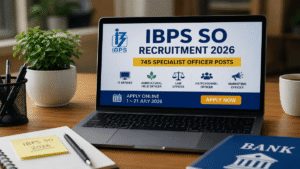
:
IBPS SO Recruitment 2026; Notification Out for 745 Posts, Apply Online, Eligibility, Exam Date & Salary
|
IBPS SO Selection Process 2026 — Overview
- Stage 1 — Online Preliminary Examination: Qualifying in nature only; sectional and overall cut-offs must be cleared to move ahead
- Stage 2 — Online Main Examination: Marks are counted in the final merit list; Professional Knowledge carries maximum weightage
- Stage 3 — Common Interview: Conducted by Participating Banks jointly with IBPS, for candidates who qualify Mains
- Stage 4 — Provisional Allotment: Based on combined Mains + Interview score in 80:20 ratio
Key Points to Remember
- Prelims score is NOT added to the final merit list — it is only a screening/qualifying round
- Professional Knowledge now appears in both Prelims and Mains — this is the biggest change in the 2026 cycle
- Candidates must clear individual sectional cut-offs as well as overall cut-off in both Prelims and Mains
- The exam is conducted bilingually (Hindi & English) for most sections, except the English Language paper, which is tested only in English
IBPS SO Recruitment 2026; Notification Out for 745 Posts, Apply Online, Eligibility, Exam Date & Salary |
IBPS SO Prelims Exam Pattern 2026 (Revised)
Group A — For IT Officer, Agricultural Field Officer (AFO), HR/Personnel Officer & Marketing Officer:
|
| Subject |
Questions / Marks / Duration |
| English Language |
25 Questions | 25 Marks | 20 Minutes |
| Reasoning Ability |
25 Questions | 25 Marks | 20 Minutes |
| Quantitative Aptitude |
25 Questions | 25 Marks | 20 Minutes |
| Professional Knowledge (NEW — Added in 2026) |
25 Questions | 50 Marks | 20 Minutes |
| Total |
100 Questions | 125 Marks | 80 Minutes |
|
Group B — For Law Officer & Rajbhasha Adhikari:
|
| Subject |
Questions / Marks / Duration |
| English Language |
25 Questions | 25 Marks | 20 Minutes |
| Reasoning Ability |
25 Questions | 25 Marks | 20 Minutes |
| General Awareness (with special reference to Banking Industry) |
25 Questions | 25 Marks | 20 Minutes |
| Professional Knowledge (NEW — Added in 2026) |
25 Questions | 50 Marks | 20 Minutes |
| Total |
100 Questions | 125 Marks | 80 Minutes |
Important Notes on Prelims Pattern:
- Each of the four sections has its own separate 20-minute sectional time limit — candidates cannot shift time from one section to another
- Although Professional Knowledge is only 25 out of 100 questions, it carries 50 out of 125 marks (40% weightage) — the single highest-weightage section in Prelims
- Individual sectional cut-offs apply on all four sections, along with an overall cut-off
- 0.25 marks deducted for every wrong answer; no penalty for unattempted questions
- Normalization of scores is applied if the exam is conducted in multiple shifts
read more; Telangana Police Constable Syllabus & Exam Pattern 2026 |
IBPS SO Mains Exam Pattern 2026 (Post-Wise)
For IT Officer, Agricultural Field Officer (AFO), HR/Personnel Officer & Marketing Officer:
|
| Test |
Questions / Marks / Duration |
| Objective Test — Professional Knowledge (Domain Specific) |
150 Questions | 200 Marks | 125 Minutes |
| Descriptive Test — English Writing (Essay / Letter Writing) |
2 Questions | 25 Marks | 30 Minutes |
| Total |
152 Questions | 225 Marks | 155 Minutes |
|
For Law Officer (Scale I):
|
| Test |
Questions / Marks / Duration |
| Objective Test — Professional Knowledge (Banking & Allied Laws) |
60 Questions | Approx. 60 Marks | 45 Minutes |
| Descriptive Test — English Writing |
2 Questions | 25 Marks | 30 Minutes |
| Total |
62 Questions | Approx. 85 Marks | 75 Minutes |
|
For Rajbhasha Adhikari (Scale I):
|
| Test |
Questions / Marks / Duration |
| Objective Test — Professional Knowledge (Hindi/Translation) |
45 Questions | Approx. 45–60 Marks | 45 Minutes |
| Descriptive Test — Translation / Essay (Hindi & English) |
2 Questions | 25 Marks | 30 Minutes |
| Total |
47 Questions | Approx. 85 Marks | 75 Minutes |
Important Notes on Mains Pattern:
- 0.25 marks deducted for every wrong answer in the Objective Test; no negative marking in the Descriptive Test
- The Descriptive (English writing) paper may be evaluated using an automated writing-assessment system, as stated in the official notification
- Professional Knowledge is the single biggest scoring component in Mains — candidates must master their domain subject in depth
- Exact question/mark split for Law Officer and Rajbhasha Adhikari Mains can see minor variation year to year — always cross-check the figures in the official IBPS SO 2026 notification PDF before finalizing your study plan
- Only candidates who clear the Mains cut-off are called for the Common Interview
read more; UPSSSC Ganna Paryavekshak Syllabus & Exam Pattern 2026 |
Common Syllabus — English Language (All Posts)
- Reading Comprehension (including inference-based and vocabulary-based passages)
- Cloze Test
- Para Jumbles / Sentence Rearrangement
- Error Detection / Spotting the Error
- Sentence Improvement & Sentence Correction
- Fill in the Blanks (Single & Double Blanks)
- Word Usage / Vocabulary-Based Questions (Synonyms, Antonyms, Idioms & Phrases)
- Word Swap & Word Replacement
- Column-Based Fillers & Match the Column
- Paragraph/Sentence Completion
read more; Rajasthan LDC Syllabus & Exam Pattern 2026 |
Common Syllabus — Reasoning Ability (All Posts)
- Puzzles & Seating Arrangement (Linear, Circular, Square, Floor-Based, Scheduling)
- Syllogism
- Blood Relations
- Direction Sense
- Coding-Decoding
- Inequality (Direct & Coded)
- Order & Ranking
- Data Sufficiency
- Input-Output
- Logical Reasoning (Statement & Assumption, Statement & Conclusion, Course of Action)
- Alphanumeric & Alphabet Series
|
Common Syllabus — Quantitative Aptitude (IT/AFO/HR/Marketing Officer)
- Simplification & Approximation
- Number Series
- Quadratic Equations
- Data Interpretation (Tabular, Bar Graph, Line Graph, Pie Chart, Caselet, Missing DI)
- Arithmetic Word Problems (Profit & Loss, SI/CI, Time & Work, Time Speed & Distance, Averages, Ratio & Proportion, Mixtures & Alligation, Partnership)
- Mensuration
- Probability & Permutation-Combination
- Data Sufficiency (Quant-based)
|
Common Syllabus — General Awareness (Law Officer & Rajbhasha Adhikari)
- Current Affairs — National & International (last 6 months)
- Banking Awareness — RBI functions, Monetary Policy, Repo/Reverse Repo Rate, NPA, Banking Ombudsman
- Static Banking Awareness — History of Banking in India, Types of Banks, Apex Institutions (RBI, NABARD, SIDBI, EXIM Bank)
- Government Schemes related to Banking & Financial Inclusion (PMJDY, PM-Kisan, PMFBY, Atal Pension Yojana)
- Important Committees, Reports & Financial Terminology
- Awards, Books & Authors, Important Days, Sports News (as applicable)
|
Post-Wise Professional Knowledge Syllabus (Detailed)
|
1. IT Officer (Scale I) — Professional Knowledge Syllabus
- Data Structures & Algorithms
- Database Management Systems (DBMS) — Normalization, SQL Queries, ER Diagrams, Transactions
- Operating Systems — Process Management, Memory Management, Deadlocks, Scheduling Algorithms
- Computer Networks — OSI/TCP-IP Model, Routing, Network Security, Protocols
- Object-Oriented Programming Concepts (C++/Java)
- Software Engineering — SDLC Models, Testing, Project Management
- Cyber Security — Cryptography, Firewalls, Threats & Attacks, IT Act 2000
- Cloud Computing — Service Models (IaaS/PaaS/SaaS), Deployment Models
- Core Banking Solutions (CBS) & IT Applications in Banking
- Digital Banking — UPI, NEFT/RTGS/IMPS, Mobile & Internet Banking, Payment Gateways
- Basic Computer Fundamentals & Number Systems
|
2. Agricultural Field Officer (AFO) Scale I — Professional Knowledge Syllabus
- Crop Production & Cropping Patterns
- Soil Science & Soil Fertility Management
- Irrigation Methods & Water Management
- Horticulture & Plantation Crops
- Animal Husbandry, Dairy & Fishery Science
- Agricultural Economics & Farm Management
- Agricultural Credit & Agri-Finance (Crop Loans, KCC, Term Loans)
- Government Agricultural Schemes — PM-KISAN, PMFBY, Kisan Credit Card, Interest Subvention Scheme
- Agricultural Marketing & Cooperation
- Plant Protection & Pest/Disease Management
- Agri-Business & Food Processing Basics
|
3. Law Officer (Scale I) — Professional Knowledge Syllabus
- Indian Contract Act, 1872 (relevant to banking transactions)
- Negotiable Instruments Act, 1881
- Companies Act, 2013
- SARFAESI Act, 2002 & DRT Act, 1993 (Secured Asset Recovery)
- RBI Act, 1934 & Banking Regulation Act, 1949
- FEMA (Foreign Exchange Management Act)
- Constitutional Law — Provisions relevant to banking administration and governance
- Procedural Laws — Basics of Civil Procedure Code (CPC) & Indian Penal Code (IPC)
- Consumer Protection Act
- Recent Amendments & Landmark Judgments relevant to the banking sector
|
4. HR/Personnel Officer (Scale I) — Professional Knowledge Syllabus
- Human Resource Management (HRM) — Concepts, Functions & Evolution
- Labour Laws — Industrial Disputes Act, Factories Act, PF Act, ESI Act, POSH Act 2013, Building & Other Construction Workers Act
- Training & Development, Learning & Development Frameworks
- Performance Management Systems & Appraisal Methods
- Compensation Management & Employee Benefits
- Organizational Behaviour & Organizational Development
- Industrial Relations & Collective Bargaining
- Recruitment & Selection Process
- HR Policies specific to Public Sector Banks
|
5. Rajbhasha Adhikari (Scale I) — Professional Knowledge Syllabus
- Hindi Grammar & Vyakaran (व्याकरण)
- Translation — English to Hindi and Hindi to English
- Hindi Linguistics & Comprehension
- Official Language Act & Rajbhasha Policy of the Government of India
- Banking Terminology in Hindi
- Essay Writing & Précis Writing in Hindi
- Noting & Drafting in Hindi (Office Correspondence)
- Implementation of Official Language in Banking Operations
|
6. Marketing Officer (Scale I) — Professional Knowledge Syllabus (No Vacancy in 2026, syllabus for reference)
- Marketing Management — Concepts, Marketing Mix (4Ps/7Ps)
- Consumer Behaviour & Market Segmentation
- Bank Marketing & Cross-Selling of Financial Products
- Digital Marketing & Social Media Marketing
- Brand Management
- Sales Management & CRM (Customer Relationship Management)
- Rural Marketing & Financial Inclusion Products
|
Prelims vs Mains — Key Differences
|
| Point of Difference |
Prelims vs Mains |
| Nature |
Prelims — Qualifying Only | Mains — Merit Deciding |
| Sections |
Prelims — 4 Sections | Mains — 1–2 Sections (Objective + Descriptive) |
| Difficulty Level |
Prelims — Easy to Moderate | Mains — Moderate to Difficult (In-Depth Domain Focus) |
| Professional Knowledge Weightage |
Prelims — 40% of Marks | Mains — 85%+ of Marks |
| Writing Component |
Prelims — None | Mains — Descriptive English Writing Test (Essay/Letter) |
IBPS SO 2026 Interview — What to Expect
- Conducted only for candidates who qualify the Mains cut-off, by the Participating Banks in coordination with IBPS Nodal Banks
- Focuses on candidate’s Professional Knowledge, communication skills, and overall suitability for a banking specialist role
- Personality, awareness of current banking developments, and reasoning ability are also assessed
- Final merit list = Mains Score + Interview Score, combined in an 80:20 ratio
- Document verification is generally carried out during/after the interview stage
|
IBPS SO Previous Year Cut Off Trend (Mains — General Category)
|
| Post / Year |
Approx. Mains Cut Off |
| IT Officer (2025) |
~55–60 (out of 85) |
| Law Officer (2025) |
~48–54 (out of 85) |
| AFO (2025) |
~45–52 (out of 85) |
| HR Officer (2025) |
~44–50 (out of 85) |
| Rajbhasha Adhikari (2025) |
~42–48 (out of 85) |
| Note: These are approximate 2025-cycle trend figures out of the old 85-mark Mains scale. Since the 2026 Mains pattern has been revised (150 Objective + 2 Descriptive for most posts, 225 total marks), the absolute cut-off numbers will change proportionally — focus on percentile/percentage performance rather than the raw number when comparing across years. Actual 2026 cut-offs will depend on exam difficulty, vacancy count, and number of candidates.
read more; CIL MT Syllabus & Exam Pattern 2026 |
IBPS SO 2026 Preparation Strategy — Subject & Post-Wise
- Professional Knowledge is priority #1 — it now appears in Prelims (50/125 marks) and dominates Mains (up to 200/225 marks). Devote 60–70% of daily study time to your domain subject from Day 1
- English Language: Read banking/financial editorials daily (Business Standard, The Hindu, Livemint); revise grammar rules and attempt one RC + one Cloze Test daily; start descriptive writing practice (essay/letter) at least 4–6 weeks before Mains
- Reasoning Ability: Focus heavily on Puzzles & Seating Arrangement (highest weightage), Syllogism, Blood Relations, Coding-Decoding and Data Sufficiency; practice one puzzle set daily
- Quantitative Aptitude: Prioritize Arithmetic and Data Interpretation, since these fetch maximum marks with moderate effort; memorise tables, squares, cubes and percentage fractions for calculation speed
- General Awareness (Law Officer/Rajbhasha): Revise last 6 months’ banking & current affairs, RBI monetary policy updates, and static banking GK weekly
- IT Officer: Build strong fundamentals in DBMS, Networking, OS and Data Structures; refer standard B.Tech CSE/IT textbooks and revise Banking IT applications (CBS, UPI, digital banking)
- AFO: Focus on government agricultural schemes (PM-KISAN, PMFBY, KCC), crop & soil science, and agri-credit/agri-finance products used by banks
- Law Officer: Master SARFAESI, DRT, RBI Act, NI Act and FEMA — these banking-specific laws carry the highest weightage in Mains
- HR Officer: Prioritize Labour Laws (Industrial Disputes Act, PF Act, ESI Act, POSH Act) and core HRM concepts
- Rajbhasha Adhikari: Practice translation (English↔Hindi) daily and revise Hindi grammar along with the Official Language Policy
- Avoid excessive guessing — 0.25 negative marking can significantly pull down your score; attempt only questions you are reasonably confident about
- Take regular full-length and sectional mock tests calibrated to the revised 2026 pattern to build speed, accuracy and exam-day temperament
|
Frequently Asked Questions (FAQs) — IBPS SO Syllabus & Exam Pattern 2026
Q1. Is Professional Knowledge included in the IBPS SO Prelims 2026?
Ans. Yes. This is the biggest change in 2026 — Professional Knowledge (25 questions, 50 marks) has been added to the Prelims exam alongside English, Reasoning and Quantitative Aptitude/General Awareness.
Q2. Does the Prelims score count towards the final merit list?
Ans. No. Prelims is purely qualifying in nature. The final merit list is based only on the Mains + Interview score, combined in an 80:20 ratio.
Q3. Is the Mains syllabus the same for all six posts?
Ans. No. English Language and Reasoning are common across posts in Prelims, but the entire Mains Professional Knowledge syllabus is different and specific to each post — IT, Agriculture, Law, HR, Marketing, and Rajbhasha Adhikari all have separate domain syllabi.
Q4. Is there negative marking in IBPS SO 2026?
Ans. Yes, 0.25 marks are deducted for every wrong answer in the Objective Tests of both Prelims and Mains. There is no negative marking in the Descriptive Test.
Q5. What is the exam medium for IBPS SO 2026?
Ans. Most sections can be attempted in Hindi or English, except the English Language section, which is tested only in English.
Q6. How many stages are there in IBPS SO Selection Process 2026?
Ans. Three stages — Preliminary Examination, Main Examination, and Common Interview — followed by Provisional Allotment.
Q7. Where can I download the official IBPS SO Syllabus PDF?
Ans. The complete syllabus and exam pattern are part of the official CRP SPL-XVI Notification PDF available on www.ibps.in.
|
important links
|
| Download Official Notification PDF (Syllabus & Pattern) |
click here |
| Apply Online (CRP SPL-XVI) |
click here (Active 1–21 July 2026) |
| Official Website |
click here |
| notification 24 jobs |
click here |
| join telegram |
click here |
| join whatsapp channel |
click here |
| susbscribe on youtube |
click here |
