The Odisha Public Service Commission (OPSC) has released the detailed OPSC AEE Syllabus and Exam Pattern 2026 for the post of Assistant Executive Engineer (Civil) under the Odisha Municipal Engineering Service Cadre.
Candidates preparing for OPSC AEE Recruitment 2026 must understand the complete syllabus, marking scheme, exam stages, and subject-wise topics to create an effective preparation strategy.
The selection process of OPSC AEE Civil 2026 will be conducted in three stages: Preliminary Examination, Main Examination, and Interview/Personality Test.
The Preliminary Examination will consist of 100 objective-type questions from Civil Engineering subjects, carrying 100 marks with a duration of 1 hour 30 minutes.
The marks obtained in Prelims will only be used for shortlisting and will not be counted in the final merit list.
The Main Examination carries 500 marks, consisting of General Studies (200 Marks) and Civil Engineering (300 Marks) papers.
The final selection will be based on Main Examination marks and the 50-mark Personality Test, making the total merit score 550 marks.
Candidates should focus on important Civil Engineering topics such as Structural Analysis, Concrete Structures, Steel Design, Geotechnical Engineering, Environmental Engineering, Transportation Engineering, Hydraulics, Irrigation, and Surveying.
For General Studies, special attention should be given to Odisha history, geography, economy, polity, culture, science & technology, and current affairs.
A proper understanding of the OPSC AEE syllabus 2026 will help aspirants plan their preparation effectively and improve their chances of success in this competitive engineering examination.
OPSC AEE Syllabus & Exam Pattern 2026 – Detailed Subject-Wise Topics, Marking Scheme & Preparation Strategy |
|
| Odisha Public Service Commission | Assistant Executive Engineer (Civil) | Group-A Odisha Municipal Engineering Service | Advt. No. 07 of 2026-27 | |
| Notification Dated: 04 August 2026 | Prelims Exam: 08 November 2026 | Updated as on 05 August 2026 | |
| Particulars | Details |
| Organization | Odisha Public Service Commission (OPSC) |
| Post Name | Assistant Executive Engineer (Civil) – Group ‘A’ |
| Cadre / Department | Odisha Municipal Engineering Service under Housing & Urban Development Department |
| Total Vacancies | 46 (15 Women) |
| Selection Stages | Preliminary Examination → Main Examination → Interview / Personality Test |
| Final Merit Basis | Main Examination (500 Marks) + Interview (50 Marks) = 550 Marks |
| Official Website | https://opsc.gov.in |
OPSC AEE Exam Pattern 2026 – Stage-Wise Complete Details |
|
| Stage 1: Preliminary Examination (Screening Test) Date: 08 November 2026 (Sunday) |
|
| Particulars | Details |
| Paper | One Paper – Civil Engineering (Objective MCQ) |
:
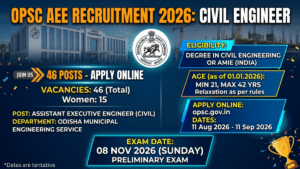
OPSC AEE Recruitment 2026; Apply Online for 46 Civil Engineer Posts
| |
| Number of Questions | 100 |
| Total Marks | 100 (1 mark each) |
| Duration | 1 Hour 30 Minutes |
| Negative Marking | 0.25 mark (25%) deducted for every wrong answer |
| Unattempted Questions | Zero marks (no penalty) |
| Mode | OMR-based or CBT (as decided by Commission) |
| Nature | Screening Test only – Marks NOT counted in final merit list |
| Shortlisting | Approximately 10 times the number of vacancies (category-wise) |
| Stage 2: Main Examination | |
| Paper | Questions / Marks / Duration |
| Paper-I (General Studies) | 100 Questions | 200 Marks (2 marks each) | 2 Hours |
| Paper-II (Civil Engineering) | 150 Questions | 300 Marks (2 marks each) | 2 Hours 30 Minutes |
| Total Written Marks | 500 Marks |
| Negative Marking | 25% of marks allotted to the question for every wrong answer |
| Mode | Objective Type MCQ (OMR or CBT) |
| Shortlisting for Interview | 1:2 ratio (minimum 5 candidates) against vacancies category-wise |
| Stage 3: Interview / Personality Test – 50 Marks | |
| Final Select List is prepared on the basis of marks obtained in Main Examination + Interview (out of 550). In case of tie, higher marks in Main Examination will be preferred; further tie resolved by age (older candidate ranked higher). | |
OPSC AEE Syllabus 2026 – Preliminary Examination (Bachelor’s Degree Standard)The Preliminary paper covers the following 10 core Civil Engineering subjects (100 questions total):
|
|
OPSC AEE Main Examination Syllabus 2026 – Paper-I: General Studies (200 Marks) |
|
| Part | Topics Covered |
| Part-I: Science & Technology | Physics | Chemistry | Geology | Communication and Information Technology | Nuclear, Space and Defence Technology |
| Part-II: General Awareness & Knowledge | (a) History of Modern India & Indian Culture: History since 1857, Freedom Movement personalities of Odisha & India, Social Reform Movements, Indian culture (ancient to modern), Odisha temple architecture, arts, crafts, dance, music, socio-cultural developments in Odisha (b) Geography of India & Odisha: Physical, economic & social geography of India; Odisha’s Physiography, Drainage system, Natural Resources (water, forest, minerals), Climate, Natural Calamities (Flood, Tsunami, Super Cyclone, Global Warming) (c) Indian Polity: Constitution of India, Political system, Government & politics in Odisha, Panchayat Raj Institutions (PRIs) in Odisha, India in World affairs (d) Indian Economy: Planning, economic development, reforms, Corporate Sector, Agricultural Economy, Fiscal policy, financial institutions, Odisha Economy (post-reform period) (e) Current Affairs: Important current issues of World, India and Odisha (including personalities & events) |
| Note: Questions are of +2 standard. Paper-I has 100 questions of 2 marks each. | |
OPSC AEE Main Examination Syllabus 2026 – Paper-II: Civil Engineering (300 Marks)150 Questions × 2 Marks = 300 Marks | Bachelor’s Degree Standard |
|
| Subject | Detailed Topics |
| 1. Solid Mechanics | Elastic constants, plane stress & plane strain, Mohr’s circle, combined stress, Elastic theories of failure, Simple bending, Shear, Torsion of circular & rectangular sections, Bending Moment and Shear Force in statically determinate beams |
| 2. Structural Analysis | Analysis of determinate structures (including graphical methods), Analysis of indeterminate skeletal frames (moment distribution, slope deflection, stiffness & force methods, energy methods, Muller-Breslau principle), Plastic analysis of indeterminate beams & simple frames, Shape factors, Basic concepts of matrix method of structural analysis |
| 3. Design of Concrete Structures | Limit state design for bending, shear, axial compression and combined forces; Codal provisions for slabs, beams, walls and footings; Principles of prestressed concrete design, materials, methods of prestressing, losses; Design of simple members |
| 4. Design of Steel Structures (Limit State Method) | Analysis and design of tension and compression members, Column bases, Connections (simple and eccentric beam-column connections), Plate girders and trusses |
| 5. Building Materials and Building Construction | Building Materials: Cement (components, types, setting times, strength), Cement Mortar, Concrete (W/C ratio, strength, admixtures, workability, testing, NDT, mix design), Bricks (types, IS classification, absorption, strength) Building Construction: Types of Foundations, Brick & Stone masonry, Floorings, Causes & prevention of cracks, Damp proofing, Special maintenance of buildings |
| 6. Estimation, Construction Planning and Management | Preliminary & Detailed estimate, Specifications and cost analysis, Bar chart, Linked bar chart, Work-breakdown structures, Activity-on-arrow diagrams, Critical path, Probabilistic activity durations, Event-based networks, PERT networks, Time-cost study, Resource allocation |
| 7. Water Resources and Hydraulic Engineering | Irrigation Engineering: Consumptive use, irrigation systems, water demand, storages & yields, ground water & well hydraulics, waterlogging, drainage, canal design (Lacey’s & Tractive force), lining, sediment transport, gravity dams, headworks, falls, cross-drainage works, river training Hydrology: Hydrological cycle, precipitation, PMP, unit hydrograph, evaporation & transpiration, floods & management, design flood, stream gauging, flood routing, reservoir capacity Fluid Mechanics: Fluid properties, pressure, thrust, buoyancy, flow kinematics, flow measurement, viscosity, boundary layer, dimensional analysis, pipe flow losses, pipe networks Open Channel Flow: Momentum & energy principles, types of flow, normal flow, gradually varied flow, hydraulic jump |
| 8. Environmental Engineering | Water Supply: Sources, intakes, demand estimation, quality standards, primary & secondary treatment, distribution systems, leakages Waste Water: Quantity & characteristics, collection, primary/secondary/tertiary treatment, sludge disposal, effluent standards Solid Waste Management: Characteristics, generation, collection, transportation, engineered systems (reuse, recycle, recovery, treatment, disposal), landfill design Air & Noise Pollution: Sources, impacts, controls, standards and limits |
| 9. Geotechnical Engineering | Soil Mechanics: Fundamental definitions, properties & classification, permeability & seepage, effective stress, shear strength, consolidation, compaction, stress distribution Foundation Engineering: Types of foundations, shallow foundations (bearing capacity, settlement), deep foundations (piles – types, capacity, group action, negative skin friction), earth pressure theories, stability of slopes, sub-surface investigations (bore holes, sampling, penetration tests, plate load tests, geophysical tests) |
| 10. Transportation Engineering | Highway Engineering: Geometric design of highways, testing & specifications of paving materials, design of flexible and rigid pavements Traffic Engineering: Traffic characteristics, theory of traffic flow, intersection design, traffic signs & signal design, highway capacity |
| 11. Surveying | Principles and classification of surveys, mapping concepts, coordinate systems, measurement of distance & directions, leveling, theodolite traversing, contours, plane table surveying, errors & adjustments, curves, total station, GPS concepts, Photogrammetry and Remote Sensing concepts |
Helpful Tips for OPSC AEE 2026 Aspirants
|
|
Important Points from Official Notification
|
|
Important Links |
|
| Official Website | https://opsc.gov.in |
| Download Official Notification & Syllabus PDF | Available on OPSC Website (Advt. No. 07 of 2026-27) |
| Online Application Window | 11 August 2026 to 11 September 2026 (5:00 P.M.) |
